
Many Shopify fashion stores focus heavily on getting more traffic. They invest in paid ads, influencer campaigns, email lists, product photography, and conversion rate optimization to acquire new customers.
Those efforts matter, but they do not guarantee long-term profitability.
A store can generate sales and still struggle with growth if most customers buy once and never return. In that situation, every new order depends on new acquisition spend. Over time, customer acquisition becomes expensive, margins become tighter, and revenue becomes harder to predict.
That is why the customer lifetime value Shopify strategy matters.
Customer lifetime value helps you understand how much revenue a customer brings to your store over the full relationship, not just from one order. Shopify explains CLV as the monetary value a customer contributes throughout their relationship with a business, and commonly connects it with average order value, purchase frequency, and customer lifespan.
For Shopify fashion stores, CLV is especially important because fashion has strong repeat purchase potential. Customers buy for new seasons, occasions, trends, wardrobe updates, size changes, and personal style preferences. But they only return when the first experience builds confidence.
In this guide, you’ll learn how to improve Shopify CLV by increasing repeat purchases, reducing returns, improving size accuracy, strengthening post-purchase experience, and building long-term customer trust.
What Is Customer Lifetime Value in Shopify?
Customer lifetime value is the total revenue a customer is expected to generate during their relationship with your Shopify store.
Instead of asking, “How much did this customer spend today?” CLV asks, “How much value can this customer generate over time?”
For example, a customer who places one $80 order is valuable. But a customer who places three $80 orders every year for three years is far more valuable. That second customer creates predictable revenue, stronger profitability, and better long-term growth.
In Shopify fashion ecommerce, CLV helps store owners understand the real value of customer relationships. It connects directly to retention, repeat purchases, average order value, customer satisfaction, and returns.
CLV vs LTV: Are They the Same?
In ecommerce, CLV, LTV, and customer LTV are often used interchangeably.
They all refer to the long-term value a customer brings to a business. Some tools may use “LTV,” while others use “CLV,” but the business meaning is usually the same: how much revenue or profit a customer generates across their full relationship with your store.
Saras Analytics explains Shopify LTV as the total revenue a business expects from a single customer over their full relationship, with the common formula using average order value, purchase frequency, and customer lifespan.
For practical Shopify reporting, the term matters less than the action behind it. Whether you call it Shopify CLV, lifetime value Shopify, or Shopify customer LTV, the goal is the same: increase the value of each customer relationship.
Why Customer Lifetime Value Matters for Shopify Fashion Stores
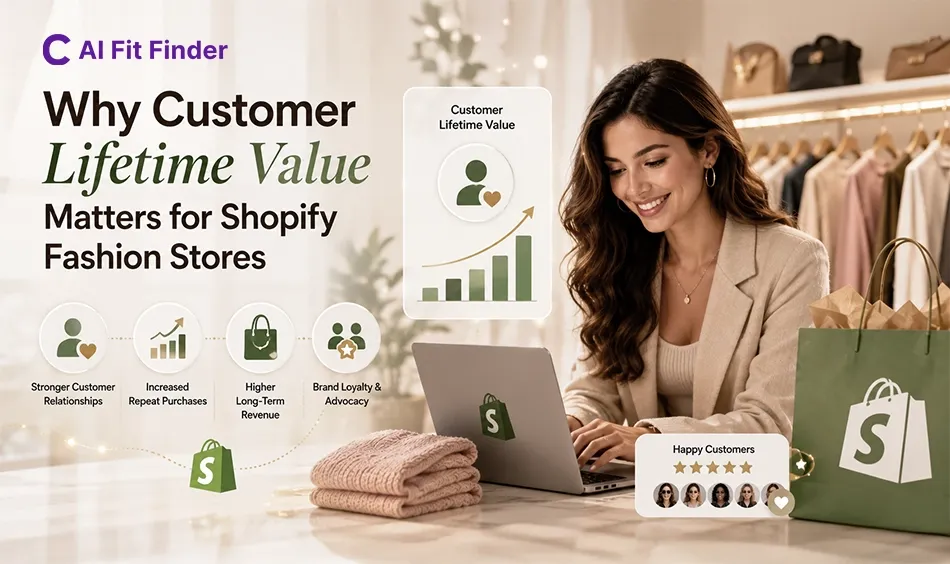
Customer lifetime value is one of the most important metrics for Shopify fashion brands because it helps answer a key business question:
Are customers coming back and spending more over time?
Fashion stores often have high acquisition costs, high return risks, and strong competition. If customers only buy once, growth becomes expensive. But when customers return, your store becomes more efficient.
Improving CLV helps Shopify fashion stores:
- Reduce dependency on paid acquisition
- Increase revenue from existing customers
- Improve marketing profitability
- Build predictable revenue
- Increase repeat orders
- Protect margins by reducing return-related losses
A higher CLV also gives you more room to invest in better products, customer experience, retention campaigns, and growth channels.
Customer lifetime value grows when customers continue buying after their first purchase. A strong Shopify customer retention strategy helps fashion stores turn first-time buyers into loyal shoppers through better post-purchase communication, sizing confidence, and repeat order systems.
How to Calculate Customer Lifetime Value on Shopify
The basic Shopify CLV formula is:
Customer Lifetime Value = Average Order Value × Purchase Frequency × Customer Lifespan
Report Pundit also explains Shopify CLV using the same standard formula: average order value multiplied by purchase frequency and average customer lifespan.
Here is a simple example for a fashion store:
| Metric | Example |
| Average Order Value | $80 |
| Purchase Frequency | 3 orders per year |
| Customer Lifespan | 2 years |
| Customer Lifetime Value | $480 |
In this example:
$80 × 3 × 2 = $480
That means the average customer generates $480 over their relationship with the store.
This number becomes more useful when compared with acquisition cost, return rate, profit margin, and repeat purchase rate.
Revenue-Based CLV vs Profit-Based CLV
Many Shopify merchants calculate CLV based on revenue. That is a good starting point, but profit-based CLV gives a clearer view of business health. Revenue-based CLV shows total customer revenue.
Profit-based CLV considers the margin after costs such as:
- Product cost
- Shipping
- Discounts
- Returns
- Payment fees
- Packaging
- Customer support
- Reverse logistics
For fashion stores, this distinction matters because returns can significantly reduce profit. A customer may generate high revenue but low profit if they frequently return products.
This is why Shopify fashion brands should not only ask, “How much does this customer spend?” They should also ask, “How much value does this customer keep after returns and costs?”
Why Customer Lifetime Value Is Low for Many Shopify Fashion Stores
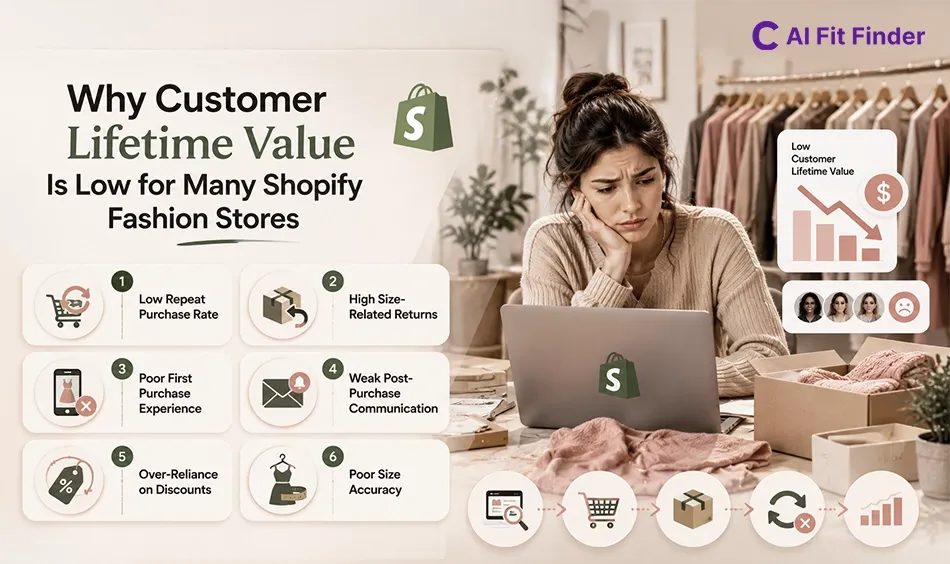
Low CLV is usually not caused by one issue. It often comes from several small customer experience gaps that reduce repeat buying.
1. Low Repeat Purchase Rate
The most obvious reason for low CLV is that customers do not buy again. A store may have strong first-time conversions, but if customers do not return, lifetime value remains limited. Repeat purchase rate is one of the strongest drivers of CLV because every additional order increases total customer value.
Repeat purchases are one of the strongest drivers of customer lifetime value. If customers buy only once, CLV remains limited. Our guide on how to increase Shopify repeat purchases explains how fashion stores can improve the first-purchase experience, reduce friction, and encourage more repeat orders.
2. High Size-Related Returns
Fashion ecommerce has a unique challenge: customers cannot try products before buying. If the product does not fit as expected, customers return it. That return creates cost, friction, and disappointment. Even if the refund is processed quickly, the customer may lose confidence in the brand.
Return Logic notes that CLV is influenced by customer experiences and touchpoints across the journey, not just by purchase history.
3. Poor First Purchase Experience
The first order shapes future buying behavior. If the customer receives a poor-fitting product, unclear delivery updates, disappointing packaging, or a product that does not match expectations, they are less likely to return. For fashion brands, the first purchase is not only a sale. It is a trust test.
4. Weak Post-Purchase Communication
Many stores stop communicating after delivery. That creates a missed retention opportunity. Customers may forget the brand or never receive guidance toward a second purchase. Strong post-purchase communication can include delivery updates, product care tips, review requests, personalized recommendations, and restock alerts.
5. Over-Reliance on Discounts
Discounts can increase short-term sales, but they do not always increase long-term loyalty. If customers only return during sales, your CLV may look higher in revenue but weaker in profitability. Discount-driven customers often have lower margin value.
6. Poor Size Accuracy
Size accuracy affects CLV because it impacts satisfaction, returns, repeat purchases, and customer loyalty. If customers trust your sizing, they are more likely to buy again. If they do not, future purchases feel risky.
Many stores rely only on size charts, but charts often require shoppers to interpret measurements on their own. Our comparison of size recommendation vs size charts explains why guided sizing can create a better customer experience and support stronger retention.
The Main Drivers of Shopify Customer Lifetime Value
To improve customer lifetime value on Shopify, you need to understand the key levers that influence it.
Average Order Value
Average order value is the amount customers spend per order. Higher AOV increases CLV when customers continue buying at the same or higher frequency. Fashion stores can improve AOV through:
- Outfit bundles
- Cross-sells
- Upsells
- Accessories
- Free shipping thresholds
- Complete look recommendations
Purchase Frequency
Purchase frequency measures how often customers buy. If customers buy twice per year instead of once, CLV increases significantly. Fashion stores can increase purchase frequency through seasonal campaigns, new arrivals, personalized recommendations, and post-purchase flows.
Customer Lifespan
Customer lifespan is how long customers continue buying from your store. The longer customers stay active, the higher their lifetime value becomes. Customer lifespan improves when customers trust the brand experience, product quality, sizing, delivery, and support.
Profit Margin
Revenue-based CLV is useful, but margin-based CLV is more realistic. If a customer buys often but returns frequently or only purchases with heavy discounts, their true value may be lower than expected.
Return Rate
Return rate directly affects CLV. High returns reduce net revenue, increase operational costs, and weaken customer confidence. For fashion brands, reducing size-related returns is one of the most important ways to protect customer lifetime value.
How Size Accuracy Improves Customer Lifetime Value
This is where Shopify fashion stores can gain an advantage over generic ecommerce brands. Most CLV guides focus on formulas, analytics, segmentation, and retention emails. Those are important. But for fashion stores, sizing accuracy is a major CLV lever.
Better Fit Increases First-Order Satisfaction
When customers receive clothing that fits as expected, they feel confident about the brand. That confidence makes the second purchase easier. A strong first-fit experience can lead to:
- Fewer returns
- Better reviews
- Stronger trust
- Higher repeat purchase likelihood
- More willingness to explore other products
Size Accuracy Reduces Returns
Every size-related return reduces customer value. It adds operational cost and creates a negative customer experience. Improving size accuracy helps customers choose the right size before purchase, reducing return risk.
Fit Confidence Increases Repeat Purchases
Customers buy again when they feel safe. If they know their size works in your store, they do not need to rethink every purchase. They can reorder faster and with less hesitation.
Better Sizing Reduces Discount Dependency
When customers are uncertain, discounts reduce perceived risk. But when customers already trust your sizing and product experience, they need fewer incentives to return. That helps protect margins and improves profit-based CLV.
Size Confidence Improves Customer Loyalty
Fashion loyalty is built on trust. A customer may like your design, but if sizing feels unpredictable, they may not return. Accurate sizing gives customers a reason to come back.
Size accuracy not only affects returns. It also shapes whether customers trust your store enough to buy again. Our guide on how size accuracy improves Shopify customer retention explains how better fit confidence supports repeat purchases, loyalty, and long-term revenue.
Proven Strategies to Improve Customer Lifetime Value on Shopify
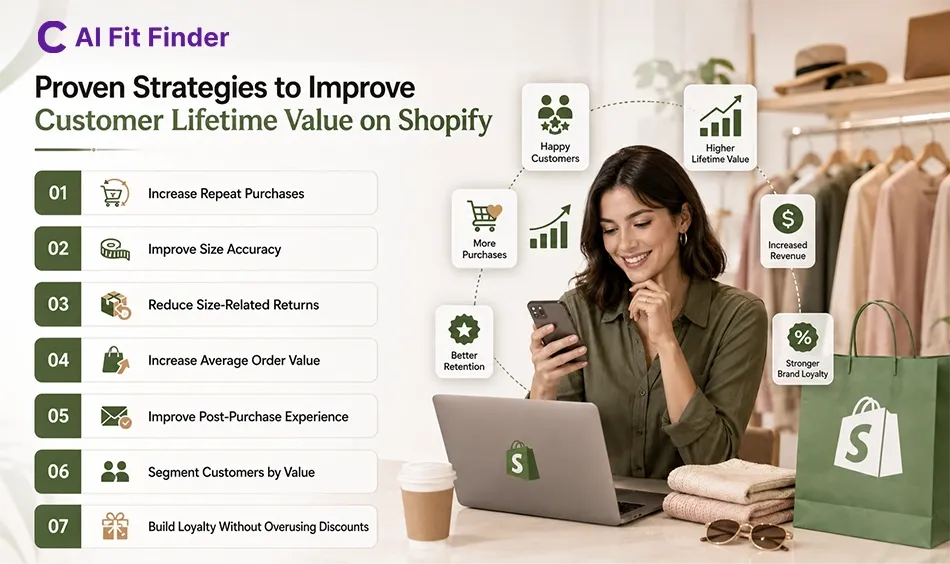
1. Increase Repeat Purchases
Repeat purchases are the foundation of CLV. To increase repeat purchases, Shopify fashion stores should focus on the journey after the first order. The goal is to turn a first-time buyer into a second-time buyer as quickly and naturally as possible. Effective tactics include:
- Post-purchase email flows
- New arrival campaigns
- Personalized product recommendations
- Reorder reminders
- Loyalty reminders
- Seasonal styling suggestions
- Category-specific follow-ups
For example, if a customer buys a summer dress, the next recommendation could include matching accessories, similar dresses, or a seasonal collection.
2. Improve Size Accuracy
Size accuracy improves both the first purchase and future purchases. Fashion stores should add:
- Product-level fit notes
- Model size references
- Fabric stretch details
- Between-size guidance
- Customer fit feedback
- Size recommendation tools
Instead of relying only on a general size chart, give customers clear, product-specific guidance.
3. Reduce Size-Related Returns
Reducing returns protects net customer value. To reduce size-related returns:
- Track return reasons
- Identify high-return products
- Update product pages based on feedback
- Improve sizing descriptions
- Add fit-specific reviews
- Use guided size recommendations
If multiple customers say a product runs small, that information should appear clearly on the product page.
4. Increase Average Order Value
AOV is one of the easiest ways to increase CLV when done without hurting conversion. Fashion-specific AOV strategies include:
- Complete outfit bundles
- “Shop the look” sections
- Matching accessories
- Free shipping thresholds
- Premium fabric upsells
- Cross-sell recommendations
The key is relevance. A random upsell can reduce trust, but a useful recommendation can improve both experience and order value.
5. Improve Post-Purchase Experience
Post-purchase experience has a major impact on whether customers return. A strong post-purchase flow may include:
- Order confirmation
- Shipping update
- Delivery confirmation
- Product care instructions
- Fit satisfaction survey
- Review request
- Personalized next-product suggestion
This keeps the relationship active after delivery.
6. Segment Customers by Value
Not all customers should receive the same retention strategy. Report Pundit highlights the value of segmenting Shopify customers into groups such as first-time buyers, repeat buyers, and loyal customers for more targeted action.
Useful segments include:
- First-time buyers
- Repeat buyers
- VIP customers
- High-return customers
- Discount-only customers
- Inactive customers
- Category-specific customers
Each segment needs different messaging.
7. Build Loyalty Without Overusing Discounts
Loyalty programs can support CLV, but discounts should not be the only reason customers return. Better loyalty strategies include:
- Early access to new collections
- VIP tiers
- Personalized rewards
- Birthday perks
- Exclusive product drops
- Private styling recommendations
The goal is to make customers feel recognized, not just discounted.
Customer Lifetime Value vs Repeat Purchase Rate
CLV and repeat purchase rate are connected, but they measure different things.
| Metric | What It Measures | Why It Matters |
| Repeat Purchase Rate | How many customers buy again | Shows retention strength |
| Customer Lifetime Value | Total revenue per customer | Shows long-term value |
| Average Order Value | Revenue per order | Shows order value |
| Purchase Frequency | How often do customers buy | Shows engagement |
| Return Rate | Orders returned | Shows experience gaps |
Repeat purchase rate is one of the main drivers of Shopify customer LTV. But CLV gives a bigger financial picture because it also includes order value and customer lifespan.
How to Improve CLV Without Increasing Traffic
Many Shopify fashion stores assume growth requires more visitors. But CLV growth comes from getting more value from customers you already acquired.
Convert First-Time Buyers Into Repeat Customers
The second purchase is often the turning point. A customer who buys twice is more likely to become a long-term customer than someone who buys once and disappears.
Recommend the Next Best Product
Use purchase history to guide the next purchase.
Examples:
- Dress buyer → matching accessories
- Jeans buyer → belt or top
- Activewear buyer → matching set
- Shirt buyer → new color or jacket
Make Reordering Easier
Reduce friction for returning customers. Helpful features include:
- Saved size preferences
- Personalized product recommendations
- Easier account access
- Past purchase visibility
- Fast checkout
Reduce Post-Purchase Friction
Customer lifetime value improves when the post-checkout experience is smooth. Focus on:
- Clear delivery updates
- Easy support
- Proactive communication
- Return prevention
- Helpful product education
Customer lifetime value improves after purchase, but the journey starts with conversion. Before customers can become repeat buyers, they need confidence to place the first order. Our guide on increasing Shopify conversion rates explains how product clarity, sizing guidance, and checkout improvements help fashion stores convert more visitors into customers.
CLV Strategy for Shopify Fashion Stores
A strong CLV strategy should be practical and measurable.
Step 1: Measure Current CLV
Start by tracking:
- Average order value
- Purchase frequency
- Average customer lifespan
- Repeat purchase rate
- Return rate
- Gross margin
This gives you a baseline.
Step 2: Segment Customers
Group customers by behavior.
Examples:
- First-time buyers
- Second-time buyers
- Loyal customers
- High AOV customers
- High return customers
- Inactive customers
Segmentation helps you create more relevant campaigns.
Step 3: Identify CLV Leaks
Look for issues that reduce lifetime value. Common CLV leaks include:
- High size-related returns
- Low second-purchase rate
- Weak post-purchase communication
- Poor sizing guidance
- High discount dependency
- Low AOV
- Inconsistent product quality
Step 4: Improve Fit Confidence
For fashion stores, fit confidence is one of the strongest customer value drivers.
Improve:
- Size guidance
- Product descriptions
- Model references
- Customer reviews
- Fabric information
- Size recommendation tools
Step 5: Increase Repeat Orders
Create flows that encourage the second and third purchase.
Use:
- New arrival emails
- Personalized recommendations
- Restock alerts
- Seasonal campaigns
- Loyalty reminders
Step 6: Monitor CLV Monthly or Quarterly
CLV should be reviewed regularly. Monthly tracking can help identify changes quickly, while quarterly reviews can provide a clearer view of long-term trends.
Tools That Help Improve Shopify CLV
Shopify Analytics
Shopify analytics can help track sales trends, customer behavior, returning customer rate, and order performance.
CLV Reporting Tools
Reporting tools can help merchants calculate Shopify customer LTV, segment repeat buyers, and identify high-value customers.
Email and SMS Marketing Tools
Retention flows help increase repeat purchases through timely communication.
Loyalty Tools
Loyalty tools support VIP tiers, points, referrals, and rewards.
Size Recommendation Tools
For fashion stores, size recommendation tools can improve fit confidence, reduce returns, and increase repeat purchase confidence.
Common Mistakes That Reduce Customer Lifetime Value
Tracking Revenue but Not Repeat Behavior
Revenue can grow while retention remains weak. If sales depend only on first-time customers, the business may still be fragile.
Ignoring Size-Related Returns
Returns reduce net customer value. If sizing problems are ignored, customers may not return.
Relying Only on Discounts
Discounts can increase short-term orders but reduce margins. They may also train customers to wait for sales.
Not Segmenting Customers
Different customers behave differently. A first-time buyer needs a different message than a VIP customer.
Treating CLV as Only a Marketing Metric
CLV is affected by marketing, but it is also shaped by product quality, sizing, delivery, support, returns, and customer experience.
Shopify Fashion CLV Growth Framework
Here is a practical framework for improving customer lifetime value in Shopify fashion stores.
Stage 1: First Purchase Confidence
Before the first order, improve:
- Product clarity
- Size guidance
- Reviews
- Trust signals
- Checkout experience
Stage 2: Post-Purchase Satisfaction
After purchase, focus on:
- Delivery updates
- Product quality
- Packaging
- Fit satisfaction
- Support
Stage 3: Second Purchase Activation
Encourage the next purchase with:
- Personalized recommendations
- Relevant email flows
- Styling suggestions
- New arrival alerts
Stage 4: Repeat Purchase Expansion
Increase customer value through:
- Cross-category recommendations
- Bundles
- Outfit suggestions
- Loyalty rewards
Stage 5: Loyalty and Long-Term Value
Build long-term relationships through:
- VIP programs
- Exclusive drops
- Personalized experiences
- Consistent sizing
- Strong customer support
This framework goes beyond the basic CLV formula. It connects customer value with the full fashion ecommerce experience.
Frequently Asked Questions
- What is a good customer lifetime value?
A good customer lifetime value depends on your product price, profit margin, purchase frequency, and customer acquisition cost. For Shopify fashion stores, a strong CLV means customers are buying more than once, returning regularly, and generating enough revenue to justify your marketing spend.
- What’s a good CLV and CAC ratio?
A commonly used benchmark for a healthy CLV to CAC ratio is 3:1. This means a customer should generate around three times more value than the cost required to acquire them. For example, if it costs $50 to acquire a customer, a healthy customer lifetime value would be around $150 or more. If the ratio is too low, acquisition may be unprofitable. If it is very high, you may have room to invest more in growth.
- How do I calculate the lifetime value of a customer?
You can calculate customer lifetime value using this simple formula:
Customer Lifetime Value = Average Order Value × Purchase Frequency × Customer Lifespan
For example, if a customer spends $80 per order, buys 3 times per year, and stays with your store for 2 years, the CLV would be:
$80 × 3 × 2 = $480
For a more accurate calculation, Shopify stores should also consider profit margin, discounts, shipping costs, and returns.
- What to do with customer lifetime value?
Customer lifetime value helps you make better business decisions. You can use CLV to decide how much to spend on customer acquisition, which customer segments to target, and where to improve retention. For Shopify fashion stores, CLV can help identify high-value customers, improve repeat purchase campaigns, reduce return-related losses, personalize product recommendations, and build stronger loyalty strategies.
- Why is CLV so important?
CLV is important because it shows how much revenue a customer can generate over time, not just from one purchase. It helps Shopify stores understand whether their growth is sustainable and profitable. A higher CLV usually means customers trust your brand, buy repeatedly, and stay loyal for longer. For fashion ecommerce, improving CLV can reduce dependence on paid ads, increase repeat orders, and improve long-term profitability.
Conclusion
Improving customer lifetime value is not just about calculating a formula. For Shopify fashion stores, CLV grows when customers trust the product experience enough to return. That trust is built through accurate sizing, clear product expectations, reduced returns, personalized communication, and consistent post-purchase satisfaction.
To improve customer lifetime value Shopify-wide, focus on the full customer journey: First purchase confidence, fit satisfaction, repeat purchase activation, higher order value, and long-term loyalty. Traffic brings customers in. Customer lifetime value keeps revenue growing.