
Shopify fashion stores often focus on getting the first sale. They optimize product pages, run paid ads, improve checkout, and offer promotions to convert visitors into customers. But long-term growth does not come from first purchases alone. It comes from customers who return. For fashion ecommerce brands, customer retention is closely connected to one factor many stores underestimate: size accuracy.
When customers receive clothing that fits as expected, they feel confident about buying again. When the fit is wrong, even if the product looks good, trust drops. The customer may return the item, hesitate before ordering again, or switch to another brand that feels safer.
That is why size accuracy Shopify-wide should not be treated as only a product page feature. It is a retention strategy.
In this guide, you will learn:
- What size accuracy means for Shopify fashion stores
- Why sizing affects customer retention
- How poor fit increase returns and reduce repeat purchases
- How size accuracy improves loyalty and customer confidence
- Practical ways to improve sizing experience on Shopify
- Metrics to track the retention impact of better sizing
What Is Size Accuracy in Shopify Fashion Stores?
Size accuracy means the size selected by a customer matches the fit they expect after receiving the product. It is not only about displaying measurements. A Shopify store may have a size chart and still create sizing confusion if customers do not know how the product actually fits.
Size accuracy includes:
- Product measurements
- Fit type
- Fabric behavior
- Body shape variation
- Customer fit preference
- Product-specific sizing differences
For example, a customer may select size M because that is their usual size. But if the product has a slim cut, rigid fabric, or brand-specific sizing, the final fit may feel too tight. From the customer’s perspective, the sizing experience failed.
In fashion ecommerce, size accuracy is about matching expectations before the purchase with reality after delivery. Size accuracy becomes difficult because customers may choose the right size label and still experience a poor fit. Differences in cut, fabric, body shape, and brand sizing all affect the final fit. Our guide on why clothes don’t fit even when the size is right explains this issue in detail and helps store owners understand why sizing needs more than a standard size chart.
Why Size Accuracy Matters More in Fashion Ecommerce
Fashion purchases are personal. Customers do not only care whether an item technically fits. They care whether it feels comfortable, looks good, and matches their preferred style.
Unlike physical retail, online shoppers cannot try products before buying. They depend on product images, size charts, fit notes, reviews, and brand trust. This makes sizing one of the most important decision points in the buying journey.
Research and industry reporting consistently point to fit and sizing as major drivers of returns, dissatisfaction, and reduced loyalty in fashion ecommerce. One recent fashion sizing survey reported that sizing inconsistencies are a major purchase deterrent, with many consumers saying fit varies by brand and affects loyalty.
For Shopify fashion stores, this means size accuracy affects more than returns. It affects whether customers feel safe buying again.
What Is Shopify Customer Retention?
Shopify customer retention is the process of encouraging customers to buy again after their first purchase. It focuses on repeat customers, repeat orders, customer satisfaction, and long-term revenue.
Shopify describes customer retention as improving the repeat customer rate and increasing the value of existing customers over time. For fashion stores, retention matters because customers may buy across:
- New collections
- Seasonal drops
- Wardrobe updates
- Occasions
- Style categories
- Matching accessories
A customer who trusts your product and fit experience is more likely to return without needing heavy discounts.
The Link Between Size Accuracy and Shopify Customer Retention
Size accuracy influences retention because the first fit experience shapes customer trust. When a customer receives a product that fits well, they learn something important about your store:
“This brand works for me.”
That confidence makes the next purchase easier. When the fit is wrong, the customer learns the opposite:
“This brand is risky.”
Even one poor fit experience can create long-term hesitation.
First Fit Experience Shapes Trust
The first order is a trust test. If the item fits as expected, the customer is more likely to:
- Keep the product
- Leave a positive review
- Trust future sizing
- Reorder similar products
- Explore more categories
If the fit is wrong, the customer may return the product and avoid buying again.
Size Confidence Reduces Purchase Risk
Every fashion purchase carries risk. Customers wonder whether the product will fit, whether it will look good, and whether returning it will be difficult. Better size accuracy reduces that risk. When customers feel confident about size, they move through the buying journey with less hesitation.
Correct Fit Increases Repeat Orders
Repeat orders become easier when customers know what size works for them. A customer who successfully buys jeans, dresses, or tops from your store is more likely to try another product if they trust your sizing. This is especially important for Shopify fashion stores that rely on repeat purchases across collections.
How Poor Size Accuracy Hurts Customer Retention
Poor sizing does not only create one return. It can damage the entire customer relationship.
It Increases Size-Related Returns
Wrong size selection is one of the most common causes of returns in fashion ecommerce. Fit-related returns create costs for the store and frustration for the customer. Some ecommerce return resources estimate that fashion return rates can be high, with fit and sizing among the most frequent causes.
Returns require the customer to:
- Repack the product
- Arrange pickup or shipping
- Wait for a refund or exchange
- Decide whether to reorder
Even if the return experience is smooth, the purchase did not end positively.
It Reduces Repeat Purchases
A customer who has already experienced a poor fit becomes more cautious.
They may think:
- “Will this happen again?”
- “Should I order two sizes?”
- “Is it worth the risk?”
- “Maybe another store has better sizing.”
This hesitation directly reduces repeat purchases.
It Weakens Customer Loyalty
Loyalty is built on confidence. If customers do not trust sizing, they do not fully trust the brand. A loyalty program may offer points or rewards, but it cannot fully solve the emotional friction of receiving clothing that does not fit.
It Increases Discount Dependency
When confidence is low, shoppers may only buy again if the discount is strong enough to justify the risk. This creates a margin problem. Instead of customers returning because they trust your store, they return only when the price reduces their hesitation.
Why Size Charts Alone Do Not Improve Retention
Many Shopify fashion stores assume that adding a size chart solves sizing problems. A size chart is helpful, but it is rarely enough.
Size Charts Require Customer Effort
Most customers do not want to measure themselves every time they shop. They may be browsing on mobile, comparing products quickly, or shopping during a short break. If the sizing process feels complicated, they delay the decision.
Size Charts Do Not Explain Fit
A size chart may show bust, waist, hip, or length measurements. But it does not always answer practical questions like:
- Does this run small?
- Is the fabric stretchy?
- Should I size up?
- Is the fit relaxed or slim?
- Will this feel tight around the waist?
Retention improves when customers understand the fit experience, not just the measurement table.
Size Charts: Ignore Body Shape and Preference
Two customers with the same measurements may prefer different fits. One may prefer a close fit. Another may prefer relaxed comfort. Static charts do not account for personal preference.
Static Charts Do Not Learn From Customer Behavior
Modern ecommerce shoppers expect guided experiences. If your store still relies only on static charts, customers must do the work themselves. This increases uncertainty and can reduce both conversions and repeat purchases.
How Size Accuracy Improves Shopify Repeat Purchases
Repeat purchases happen when customers feel safe buying again. Size accuracy supports this in several ways.
It Makes Reordering Easier
When customers know their size works, they do not need to restart the decision process every time. They can buy faster.
It Encourages Multi-Category Shopping
A customer who trusts sizing in one product category may feel confident trying another. For example:
- Dress buyer explores tops
- The jeans buyer tries on the trousers
- Activewear buyer buys matching sets
- The shirt buyer tries jackets
This expands revenue potential.
It Reduces Return Anxiety
When customers expect the right fit, they are less worried about returns. Return anxiety is important because shoppers increasingly consider return policies before buying. Recent retail reporting found that many shoppers check return options before purchase, and poor return experiences can discourage future buying.
It Builds Long-Term Brand Familiarity
A reliable fit creates familiarity. Customers begin to associate your store with confidence, not risk. That familiarity supports repeat purchases and customer loyalty.
Repeat purchases increase when customers feel confident buying again. If you want to explore this topic further, our guide on how to increase Shopify repeat purchases explains how fashion stores can improve customer experience, reduce friction, and encourage more repeat orders.
How Size Accuracy Reduces Returns and Improves Loyalty
Returns are not just a logistics issue. They are a retention issue. A return means the customer’s expectation was not met.
Returns Add Friction to the Customer Journey
Even when returns are free or easy, they still require effort. The customer has to spend time fixing a problem that could have been prevented before purchase.
Returns Break Post-Purchase Satisfaction
A customer who returns a product because of fit rarely feels fully satisfied. They may appreciate the return policy, but the product experience failed.
Reduced Returns Improve Customer Confidence
When customers keep what they buy, trust grows. Lower return rates usually indicate better expectation-setting, better product clarity, and stronger customer satisfaction.
For fashion stores, this is critical because returns can create major cost and operational pressure. A 2025 study on fashion ecommerce returns noted that fashion returns create major reverse logistics complexity and are often influenced by sizing, preferences, and trend-driven behavior.
Practical Ways to Improve Size Accuracy on Shopify
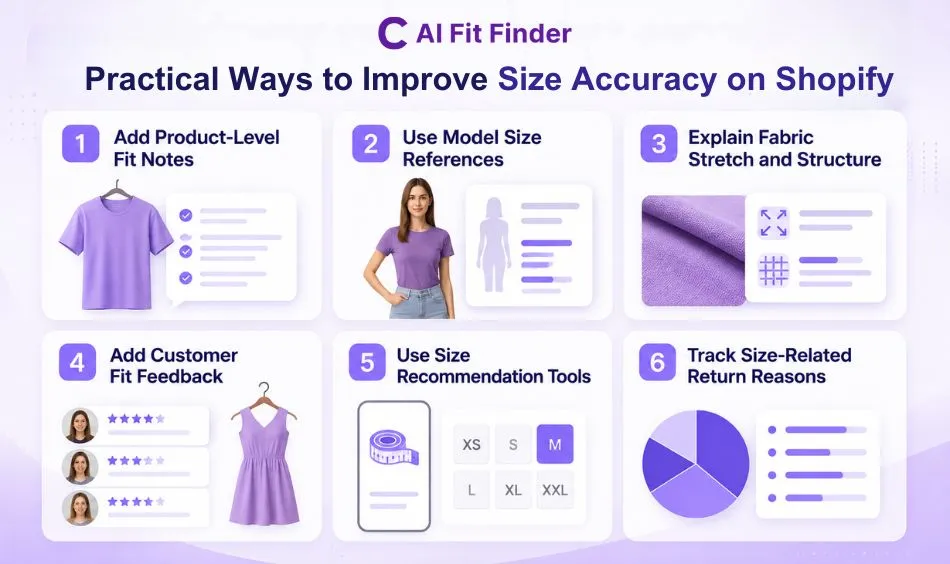
Improving size accuracy requires more than adding one chart to every product page. It requires better product-level guidance and continuous learning from customer behavior.
1. Add Product-Level Fit Notes
Every product should explain how it fits. Useful fit notes include:
- Slim fit
- Regular fit
- Relaxed fit
- Oversized fit
- Runs small
- True to size
- Size up if between sizes
- Size down for a closer fit
These notes help customers make decisions faster. For example:
Instead of writing:
“Women’s cotton shirt”
Write:
“Relaxed-fit cotton shirt with light structure. Choose your usual size for a comfortable fit or size down for a closer look.” This gives the shopper practical guidance.
2. Use Model Size References
Model size references help customers visualize fit.
Include:
- Model height
- Model body measurements
- Size worn
- Fit the description on the model
Example:
“Model is 5’7″ and wears size M. The dress has a relaxed fit through the waist.” This gives shoppers a real-world reference point.
3. Explain Fabric Stretch and Structure
Fabric affects fit significantly. A size M in a stretchy knit may feel very different from a size M in rigid denim. Add details such as:
- High stretch
- Slight stretch
- Non-stretch
- Structured fabric
- Lightweight fabric
- Thick fabric
- Body-hugging material
This helps shoppers understand how the product will behave when worn.
4. Add Customer Fit Feedback
Customer reviews are powerful because they come from real buyers. Encourage shoppers to leave fit-related feedback, such as:
- True to size
- Runs small
- Runs large
- Comfortable fit
- Tight at the waist
- Loose around the shoulders
- Size purchased
- Body type reference
Fit feedback helps future customers make better decisions. It also helps store owners identify product-level sizing issues.
5. Use Size Recommendation Tools
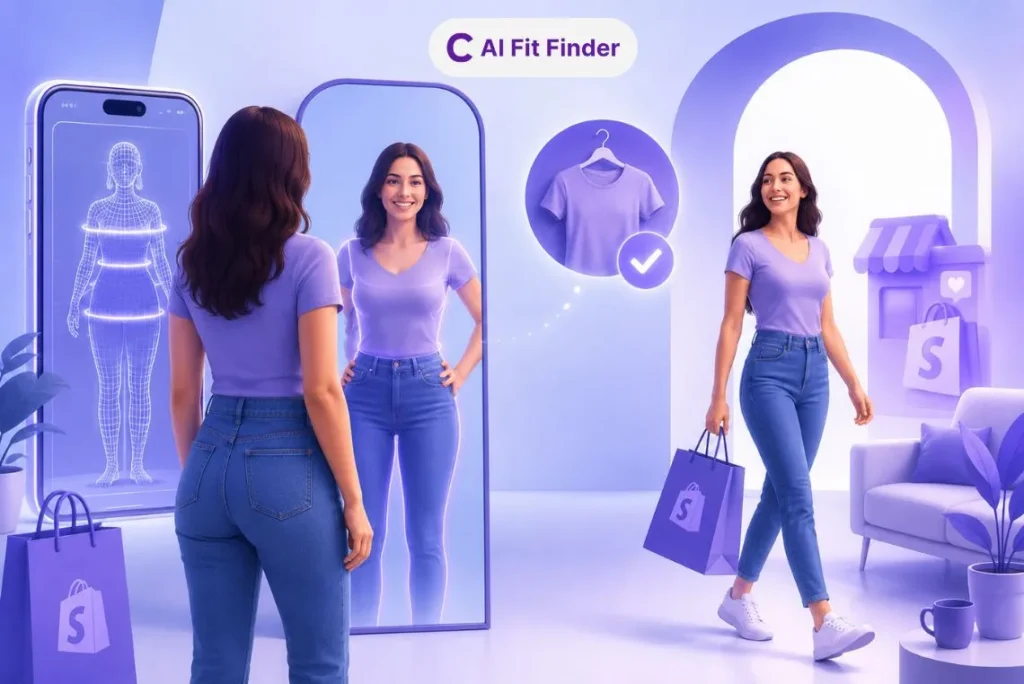
Size recommendation tools help customers choose the right size with less guesswork. Instead of asking customers to interpret tables alone, these tools can guide them based on inputs, preferences, and product-level logic.
For Shopify fashion stores, size recommendation tools can support:
- Conversion rate
- Return reduction
- Customer satisfaction
- Repeat purchase confidence
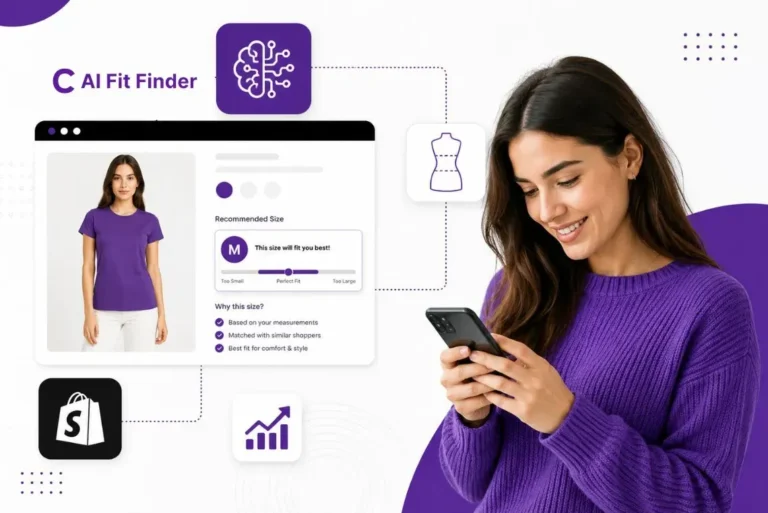
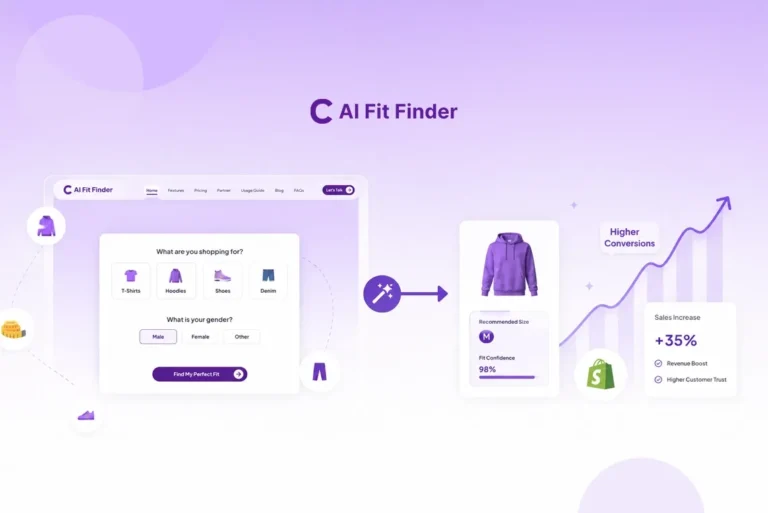
This is where AI Fit Finder can fit naturally into the customer journey. The goal is not just to recommend a size. The goal is to help customers buy with confidence.
6. Track Size-Related Return Reasons
Return data is one of the best sources of sizing insight. Track return reasons such as:
- Too small
- Too large
- Fit not as expected
- Fabric not comfortable
- Length issue
- The style did not suit the body type
Then use this data to update product pages. If customers repeatedly say a product runs small, update the product page instead of letting future customers make the same mistake.
Size Accuracy vs Loyalty Programs: What Drives Retention Better?
Loyalty programs can help, but they do not fix poor product experience.
| Factor | Loyalty Program | Size Accuracy |
| Builds product trust | Medium | High |
| Reduces returns | Low | High |
| Improves first purchase satisfaction | Medium | High |
| Encourages repeat orders | Medium | High |
| Protects margins | Medium | High |
| Reduces purchase hesitation | Low | High |
A loyalty program gives customers a reason to return. Size accuracy gives them confidence to return. For fashion stores, confidence often matters more than points.
Size accuracy and Customer Lifetime Value
Customer lifetime value increases when customers buy repeatedly and stay with the brand longer. Size accuracy supports both.
Correct Fit Increases Purchase Frequency
Customers buy more often when they trust the buying experience. If the first few orders fit well, customers become more willing to explore new products.
Lower Returns Protect Profit
Returns reduce retained revenue. When size accuracy improves, fewer orders come back. This protects profit margins and improves net revenue per customer.
Trust Increases Long-Term Value
Customers who trust sizing are more likely to:
- Reorder
- Buy at full price
- Recommend the brand
- Leave positive reviews
- Try new categories
That trust increases lifetime value.
Retention benchmark reports often show ecommerce retention varies by vertical, with fashion facing lower retention than some repeat-consumption categories. That makes experience quality especially important for Shopify fashion brands.
Metrics to Track the Retention Impact of Size Accuracy
To understand whether better sizing improves retention, track the right metrics.
Size-Related Return Rate
Measure how many returns happen because of size or fit. This is one of the most important metrics for fashion stores.
Repeat Purchase Rate
Track how many customers buy again after their first order. If sizing improves and repeat purchase rate increases, your store is building stronger trust.
Customer Lifetime Value
Track whether customers are spending more over time. Better fit confidence can increase customer lifetime value by supporting repeat purchases.
Return Rate by Product
Some products may have higher fit issues than others. Track returns at the product level, not only the store level.
Fit Feedback in Reviews
Look for patterns in customer reviews. Repeated phrases like “runs small” or “tight fit” should lead to product page updates.
Common Mistakes That Reduce Size Accuracy and Retention
Many stores unintentionally create sizing friction.
Using One Generic Size Chart for All Products
Different products fit differently. A generic chart may not reflect product-specific cut, fabric, or stretch.
Ignoring Return Reasons
If customers repeatedly return items for the same fit issue, that data should guide improvements.
Not Updating Product Pages After Feedback
Product pages should evolve based on real customer feedback. If a product runs small, say so clearly.
Hiding Fit Details Below the Fold
Sizing guidance should be easy to find before checkout. If customers have to search for fit information, many will leave.
Treating Sizing as a Support Issue
Sizing is not only a support problem. It affects conversion, returns, repeat purchases, customer loyalty, and revenue.
Tools That Help Improve Size Accuracy on Shopify
The right tools help reduce guesswork and improve customer confidence.
Size Recommendation Tools
These guide customers toward the best size using inputs and product-level rules.
Reviews and Fit Feedback Tools
These collect customer insights about fit, size, comfort, and product expectations.
Analytics Tools
These help identify return trends, product-level issues, and buyer behavior patterns.
Personalization Tools
These can use customer history to improve future recommendations. Together, these tools help fashion stores move from static sizing to guided sizing.
The Size Accuracy Retention Framework
To make size accuracy part of customer retention, use a structured process.
Step 1: Identify Size Friction
Review:
- Return reasons
- Customer support tickets
- Product reviews
- Size exchanges
- Abandoned carts
Look for patterns.
Step 2: Improve Product-Level Fit Guidance
Add:
- Fit notes
- Fabric behavior
- Model references
- Between-size guidance
- Customer fit feedback
Step 3: Add Guided Size Recommendations
Use sizing tools to reduce customer effort and provide clearer direction.
Step 4: Measure Return and Repeat Purchase Impact
Track whether sizing improvements reduce returns and improve repeat purchases.
Step 5: Keep Improving With Customer Feedback
Sizing is not a one-time setup. Use real customer data to improve product pages continuously.
Frequently Asked Questions About Shopify Customer Retention
- What is the best size for Shopify products?
The best image size for Shopify product photos is usually 2048 × 2048 pixels with a 1:1 square aspect ratio. Shopify supports product and collection images up to 5000 × 5000 pixels or 25 megapixels, with a file size under 20 MB. For Zoom functionality, product images should be at least 800 × 800 pixels. For fashion stores, keeping product images consistent in size and aspect ratio helps product pages look cleaner and improves the shopping experience.
- What is smart size?
Smart size usually refers to a guided size recommendation that helps shoppers choose the right clothing size based on inputs such as body measurements, fit preference, product type, and sizing logic. Unlike a static size chart, smart sizing gives customers a more personalized recommendation. For Shopify fashion stores, smart size tools can reduce guesswork, improve size accuracy, lower returns, and increase customer confidence.
- How to put sizes on Shopify?
You can add sizes on Shopify by creating product variants. In the Shopify admin, open the product, go to the variants section, add an option such as Size, and enter values like S, M, L, XL, or numeric sizes such as 28, 30, 32. For fashion stores, it is also helpful to add a size chart, fit notes, model size reference, and size guidance on the product page so customers can choose more confidently.
- Is it better to resize or crop an image?
It depends on the goal. Resize an image when you want to reduce file dimensions or improve loading speed without changing the full image composition. Crop an image when you need to adjust the frame, remove extra space, or match a specific aspect ratio. For Shopify product images, it is usually best to crop first for consistent framing and then resize for performance. This keeps product grids clean while avoiding unnecessarily large image files.
- What is the best size for Shopify: high resolution or web size?
For Shopify, the best approach is to use high-quality web-optimized images, not oversized raw high-resolution files. A good standard for product images is 2048 × 2048 pixels, which gives enough clarity for zoom while still being manageable for page speed. Shopify allows images up to 5000 × 5000 pixels and under 20 MB, but very large files can slow down your store if they are not optimized. For fashion ecommerce, the goal is to balance image clarity with fast loading, especially on mobile devices.
Conclusion
Size accuracy is not just a sizing feature. It is a customer retention strategy. For Shopify fashion stores, the first fit experience often determines whether a customer returns. If the product fits well, trust increases. If the product does not fit, returns rise and repeat purchases decline.
Improving size accuracy Shopify-wide helps fashion brands reduce returns, increase repeat purchases, and build stronger customer loyalty. Loyalty does not start with points or discounts. It starts with confidence. When customers trust your sizing, they trust your store. And when they trust your store, they come back.